Last Updated: 3rd June, 2026 | 07:06:35 PM
PTE Eligibility for Studying Abroad
PTE Eligibility for Studying Abroad

The Pearson Test of English (PTE) has become one of the most popular English language proficiency tests for students aspiring to study abroad. Many universities and colleges across the globe accept PTE scores as proof of English proficiency. Understanding the PTE eligibility criteria for studying abroad is essential for prospective international students to plan their applications effectively.
The Pearson Test of English (PTE) Academic is a leading computer-based English language proficiency test accepted by thousands of universities, colleges, and professional bodies globally. Whether you are aiming for study abroad opportunities, migration, or professional certification, understanding how "eligibility" and "scoring" interact is crucial for your success.
What is PTE?
The PTE Academic is a computer-based English language test designed to assess the readiness of non-native English speakers to participate in academic environments where English is the medium of instruction. It evaluates listening, reading, speaking, and writing skills.
For more on what the PTE exam entails, visit PTE Scores and Results FAQ
Why is PTE Important for Studying Abroad?
Most universities require proof of English proficiency to ensure that students can cope with academic coursework and social interactions. The PTE is accepted by thousands of institutions worldwide, including universities in Australia, Canada, the UK, and the USA.
Learn more about universities accepting PTE scores at How to send PTE Academic Scores to Colleges
Who is Eligible to Take the PTE Exam?
Generally, anyone planning to study or work abroad who needs to demonstrate English proficiency can take the PTE Academic test. There are no strict age limits or prerequisites, but candidates should have a basic knowledge of English to perform well.
For eligibility criteria and test registration guidelines, check PTE Online Exams Coaching
PTE Accepted Universities in UK FAQs
PTE Score Requirements for Studying Abroad
Different institutions and programs have varied minimum score requirements. Typically, a score of 50 to 65 is considered sufficient for undergraduate programs, while postgraduate courses may require scores upwards of 65.
To understand score requirements for specific courses or universities, visit Pearson Test of English Academic accepted by New Zealand
Additional Eligibility Factors for Studying Abroad
Beyond the PTE score, universities may also require:
- Academic transcripts and certificates
- Proof of financial capacity
- Visa eligibility (which also considers English proficiency)
- Other standardized test scores (depending on the program)
For visa and admission advice, see PTE Score Conversion to IELTS and TOEFL iBT Scores
Steps to Confirm Your PTE Eligibility for Study Abroad
- Research the university requirements: Check the official websites or trusted portals for English proficiency minimums.
- Prepare adequately: Use PTE online coaching or study resources to meet the required scores.
- Register for the test: Follow official registration procedures to book your exam.
- Send your scores: After obtaining your results, send them to the institutions where you are applying.
For detailed study guides and coaching options, explore PTE Home Testing
What If You Don’t Meet the PTE Eligibility Criteria?
If your scores don’t meet the eligibility criteria:
- Consider retaking the PTE after additional preparation.
- Explore alternative English tests accepted by your desired institution.
- Opt for pathway or foundation programs that have lower language requirements.
In summary, understanding PTE eligibility for studying abroad ensures you meet the language requirements essential for academic success overseas. Proper preparation and knowledge of requirements are key to a smooth admission process. For more insights and updates on PTE and studying abroad, continue exploring nounloaded.com.ng.
What is the PTE Eligibility Score?
It is important to clarify a common misconception: there is no universal "passing" or "eligibility" score for the PTE Academic.
Because the PTE is used for a vast array of purposes—ranging from university admissions to skilled migration visas—the required score is determined entirely by the receiving institution or government authority, not by Pearson (the test provider).
1. Academic Institutions
Universities and colleges set their own English language proficiency requirements.
Undergraduate Programs: Often require a score between 50 and 60.
Postgraduate/Master’s Programs: Usually demand higher scores, typically ranging from 60 to 75.
Prestigious/Research Programs: May require 75 or higher to demonstrate advanced proficiency.
2. Migration and Professional Bodies
If you are taking the test for visa purposes (e.g., Australian or New Zealand migration) or for registration with a professional board (e.g., nursing or engineering), the requirements are strictly dictated by government frameworks.
Competent English: Often equated to a score of 50 in each of the four communicative skills (Listening, Reading, Speaking, and Writing).
Proficient English: Often requires a score of 65 in each communicative skill.
Superior English: Often requires a score of 79 in each communicative skill to maximize points for visa applications.
How the PTE is Scored
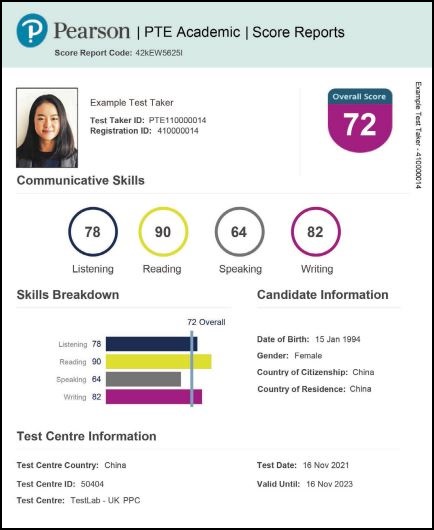
The PTE Academic is fully automated using AI, which ensures objective and consistent scoring. Your final score is reported on the Global Scale of English (GSE), a scale from 10 to 90.
The Scoring Breakdown
Your test report provides a granular view of your performance:
Overall Score: An aggregate score of your overall English proficiency (10–90).
Communicative Skills: Separate scores for Listening, Reading, Speaking, and Writing (10–90).
Enabling Skills: Performance metrics in Grammar, Oral Fluency, Pronunciation, Spelling, Vocabulary, and Written Discourse.
Key Takeaway: Always check if the institution requires an Overall Score or a minimum score in each of the four communicative skills. Many organizations have a "minimum threshold" rule (e.g., "Overall 65, with no band less than 60").
Strategic Steps to Meet Your Target Score
Since the "eligibility" varies, your preparation must be tailored to the specific requirements of your destination.
| Step | Action |
| Verify Requirements | Check the official website of your target university, visa authority, or professional body for their specific score requirements. |
| Take a Mock Test | Use a full-length, AI-scored practice test to establish a baseline. This helps you identify which of the four skills needs the most improvement. |
| Understand the Format | The PTE evaluates integrated skills. For example, a "Read Aloud" task in the Speaking section also contributes to your Reading score. Mastery of the task types is more important than general English improvement alone. |
| Analyze Weaknesses | Focus your study time on your lowest-performing communicative skill while maintaining your strengths in others. |
Final Thoughts
The PTE score you need is not a static number—it is a goalpost defined by your specific ambitions. By researching the precise requirements of your chosen institution early, you can convert the PTE from a daunting hurdle into a clear, achievable milestone.
You may also
like;
PTE
Accepted Universities in UK FAQs
Pearson
Test of English Academic accepted by New Zealand
PTE
Score Conversion to IELTS and TOEFL iBT Scores
Related Posts

PTE Scored Practice Tests...
3rd June, 2026
PTE Exams Preparation ...
3rd June, 2026
PTE Syllabus FAQ...
3rd June, 2026
PTE Exam Preparation Tips...
3rd June, 2026
PTE Mock Test FAQs...
3rd June, 2026
How to send PTE Academic Scores to Colleges...
3rd June, 2026
PTE Online Exams Coaching...
3rd June, 2026
PTE Scores and Results FAQ...
3rd June, 2026
PTE Result...
3rd June, 2026
PTE Exam Books FAQs...
3rd June, 2026
PTE Cut Off...
3rd June, 2026
PTE Home Testing...
3rd June, 2026
Categories
Blog Posts






Breaking News
We usually sends BREAKING News to students of National Open University, NOUN. Not to miss any of our latest updates, enter your email here