Last Updated: 31st May, 2026 | 08:39:52 PM
GRE General vs. Subject Tests
GRE General vs. Subject Tests: A Comprehensive Guide for Applicants
For students preparing for graduate studies abroad, the GRE (Graduate Record Examinations) is a familiar milestone. However, distinguishing between the two primary test types—the GRE General Test and the GRE Subject Tests—is crucial for building an effective application strategy.
1. The GRE General Test
The GRE General Test is the most widely accepted graduate admissions exam in the world.
What it Measures:
Verbal Reasoning: Your ability to analyze and synthesize written material.
Quantitative Reasoning: Your capacity to interpret data and apply mathematical concepts in algebra, geometry, and data analysis.
Analytical Writing: Your skill in articulating complex ideas and evaluating arguments through focused, coherent essays.
Purpose: It serves as a universal yardstick for admissions committees, helping them assess your critical thinking and problem-solving readiness.
Most Master’s, MBA, and doctoral programs require this score as part of their standard academic requirements
2. The GRE Subject Tests
While the General Test measures broad aptitude, the GRE Subject Tests are achievement tests.
Focus Areas: These tests are available in selected subjects, such as Physics, Mathematics, and Psychology.
Purpose: Subject Tests are typically required by highly specialized programs or competitive fellowship panels.
They allow candidates who have a strong background in a specific field to demonstrate their expertise beyond what is reflected in their undergraduate transcripts. When to take it: You should only register for a Subject Test if your target program specifically requests it or if you wish to distinguish your application in a highly technical field.
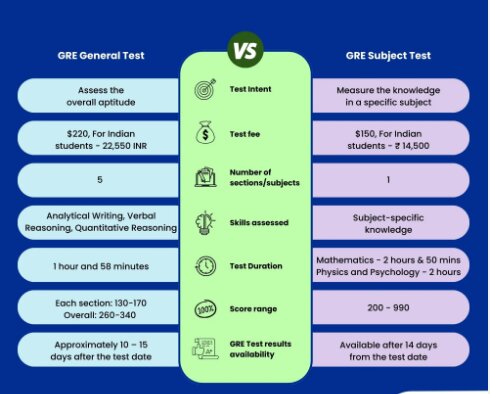
3. Key Differences at a Glance
| Feature | GRE General Test | GRE Subject Tests |
| Primary Goal | Assesses broad academic aptitude | Evaluates specialized knowledge |
| Sections | Verbal, Quantitative, Writing | Discipline-specific (e.g., Physics, Math) |
| Acceptance | Widely accepted by most graduate schools | Required by select specialized programs |
| Exam Duration | Approximately 1 hour 58 minutes | Varies by subject |
4. Strategic Planning
Deciding whether to take one or both tests depends entirely on the specific requirements of the universities you are applying to. As you gather your
Check Program Requirements: Always visit the official admissions pages of your target universities. If they do not explicitly ask for a Subject Test, focusing your energy on a high General Test score is usually the better investment.
Timing: The General Test is available year-round, while Subject Tests have specific testing windows.
Plan your testing schedule at least 6–8 months before your application deadlines. Preparation: Because the two tests assess very different things, their preparation methods differ. While the General Test focuses on critical thinking and logic, Subject Tests require intensive review of undergraduate-level textbooks and theory.
If you are currently in the process of applying to international institutions, ensure you have your
Related Posts;
IELTS
Writing Task 2 FAQsIntroductionIELTS Writing
Scholarships
at Wichita State University (WSU)
GMAT
Score/Results: A Complete Guide1. Introduction
Mastering Your IELTS
Test Day: A Comprehensive Guide
University
of Waterloo Scholarships
Related Posts
GRE Sample Essay 12 ...
31st May, 2026
GRE Sample Essay 4...
31st May, 2026
GRE Sample Essay 11 ...
31st May, 2026
Categories
Blog Posts






Breaking News
We usually sends BREAKING News to students of National Open University, NOUN. Not to miss any of our latest updates, enter your email here